
The best OTP suppliers do more than send a code: they help it reach users quickly and reliably across regions. Use under 10 seconds as a practical target for SMS delivery, then compare routing quality, fallback channels, and verification success.
An OTP service provider delivers one-time codes through channels such as SMS, voice, email, or WhatsApp. Fast delivery matters, but a code that arrives late or fails on a local route can still block sign-ups and logins.
This comparison explains how OTP suppliers differ and what to assess in their delivery and security capabilities. It also covers when building verification in-house may make sense. Use the framework to compare coverage, fallback options, and successful verification.
Key Takeaways
- Map your users’ countries and sign-up flows before comparing providers. Regional coverage and route quality shape the verification experience.
- Compare the ongoing work of maintaining an in-house OTP system with the operational support a provider can supply.
- Plan fallback channels around user access and recovery needs so a failed SMS doesn’t end the verification attempt.
- For US verification, compare providers on integration fit, fraud controls, and the ability to support your expected traffic patterns.
Table of Contents
Delivery speed, routing quality, and global coverage
SMS OTPs can be delayed, blocked, or exposed through a compromised channel. Callsign describes SIM-swap, call-forwarding, and SS7 attacks as increasingly difficult to detect, while the National Institute of Standards and Technology (NIST) notes that an out-of-band secret can be intercepted if its communication channel is compromised.
Provider Coverage and Localization
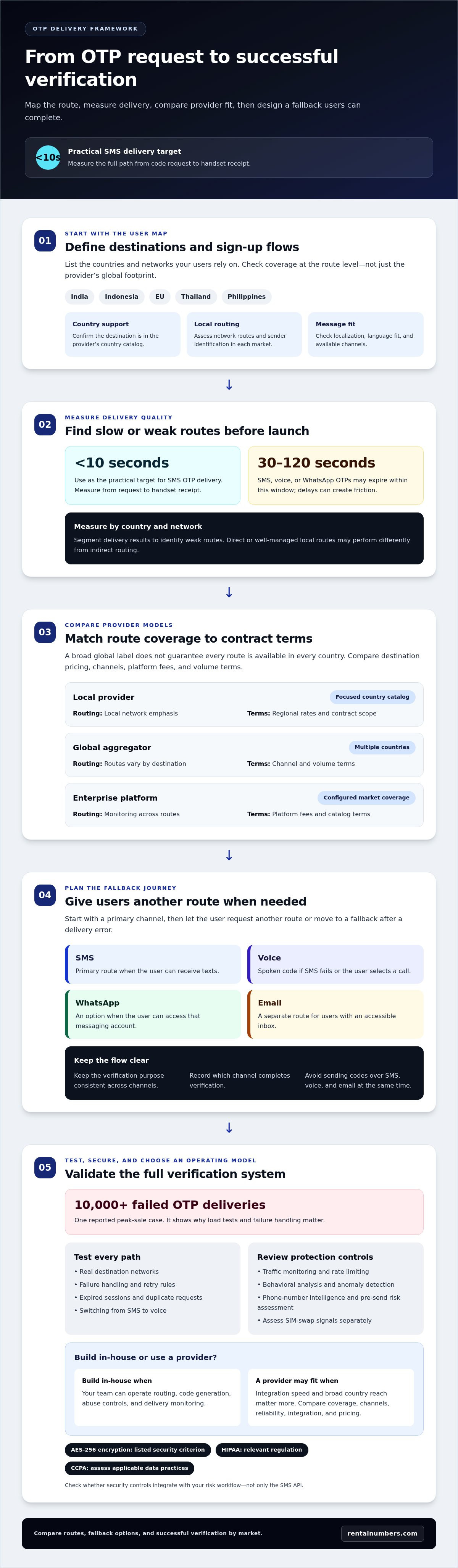
Compare country coverage at the route level, not just by a provider’s global footprint. If your service is used in India, Indonesia, and the EU, confirm support for each destination and assess local network routing, sender identification, and language fit. Localization affects whether a message is clear and reaches the intended network. Review the provider’s country catalog and the channels available in each market.
Delivery Speed and Routing Quality
Use under 10 seconds as the target for OTP delivery. Measure the full path from code request to handset receipt, then segment results by country and network to find weak routes. A provider with direct or well-managed local routes may perform differently from one relying on indirect routing. Also account for the code’s short lifetime: SMS, voice, or WhatsApp OTPs expire in 30-120 seconds, so delays can create friction even when a message eventually arrives.
Compare pricing by destination, channel, platform fees, and volume terms. For enterprise use, check whether the contract covers the countries, networks, and fallback channels your service needs, or only a subset. A broad global label does not guarantee that every route is available in every country.
| Option | Coverage | Routing and delivery | Pricing and terms |
|---|---|---|---|
| Local provider | Focused country catalog | Local network emphasis | Regional rates and contract scope |
| Global aggregator | Multiple countries | Routes vary by destination | Channel and volume terms |
| Enterprise platform | Configured market coverage | Monitoring across routes | Platform fees and catalog terms |
Choose based on how well a provider’s routes, fallback options, and contract coverage fit your most important user countries.
Should You Build Your Own OTP System or Use a Provider?
Decide whether to build the verification stack in-house or integrate a service provider. Before committing, compare engineering effort, country coverage, integration requirements, and fraud controls.
Using an OTP Provider
A provider supplies the platform and API for sending and validating codes. Compare Twilio, Vonage, Sinch, Infobip, and AWS by country coverage, integration, channel options, reliability, and pricing, not by name alone. Review the documentation and test delivery in the countries where your users sign up. Using a provider can reduce the need to build network connections and routing logic internally.
Regional Provider Options
For India and Southeast Asia, compare regional providers and global platforms against your target countries and networks. A provider focused on India may offer a different route mix from one serving Indonesia, Thailand, and the Philippines. Test delivery, sender recognition, localization, and fallback options for each destination. Treat every country as a separate integration case instead of assuming one regional setting fits all markets.
Provider Evaluation Criteria
Build in-house when your team can operate routing, code generation, abuse controls, and delivery monitoring. A provider may fit better when integration speed and broad country reach matter more. One reported peak-sale case had more than 10,000 failed OTP deliveries, showing why load tests matter. Test with real destination networks, failure handling, and retry rules before launch. Review API documentation and compare regional rates, platform fees, other verification methods, and volume discounts.
Provider Security and Protection Features
Evaluate Twilio, Vonage, Sinch, Infobip, and AWS for traffic monitoring, rate limiting, behavioral analysis, phone-number intelligence, anomaly detection, and pre-send risk assessment. Assess SIM-swap signals separately. For United States use, review documented security controls and applicable frameworks. AES-256 encryption is a listed security criterion; HIPAA is a relevant regulation, according to the U.S. Department of Health and Human Services. Also assess CCPA requirements for applicable data practices. Ask whether controls integrate into your own risk workflow, not just the SMS API.
SMS, voice, email, and messaging-channel fallback
SMS is only one way to deliver a verification code. WhatsApp, voice, and email add alternative channels, but each changes the user flow. Design fallback around the transaction and the contact details already available, rather than automatically retrying every channel after a failure.
For example, a sign-up can start with SMS and offer voice if the user reports that the text did not arrive. WhatsApp may suit users who already use that service, while email can be an alternative when a phone route is unavailable. Keep the verification purpose consistent across channels and make the next step clear on screen.
Designing a Fallback Flow
Set routing rules before launch. Start with the primary channel, then let the user request another route or move to a fallback after a delivery error. Record which channel completes verification. Avoid sending codes over SMS, voice, and email at the same time: duplicate messages can confuse users and complicate auditing.
- SMS: Use it as the primary route when the user can receive texts.
- Voice: Offer a spoken code when SMS delivery fails or the user selects a call.
- WhatsApp: Include it when the user can access that messaging account.
- Email: Keep it as a separate route for users with an accessible inbox.
Test every path in the integration, including expired sessions, duplicate requests, and users switching from SMS to voice. During high-volume periods, monitor completion by channel, country, and failure reason. Reporting should distinguish requested, delivered, and successfully entered codes, helping teams identify whether friction comes from routing or the interface.
Choose an OTP service with channel options that suit your users and transaction risk. A low-risk sign-in may need a simple fallback, while a sensitive account change may require additional risk checks before another channel is offered. Keep routing rules consistent across the platform and show users which channel will receive the next code.
What are the best OTP SMS verification providers in the United States?
Twilio, Vonage, Sinch, Infobip, and AWS are five providers to compare for US OTP verification. The right fit depends on your integration, traffic profile, fraud controls, and required channels. Test each against the same use case before ranking them.
| Provider | Compare in your evaluation |
|---|---|
| Twilio | API fit, US route results, fraud controls, and pricing structure |
| Vonage | Documentation, channel options, and integration workflow |
| Sinch | Coverage, delivery reporting, and risk-control options |
| Infobip | Channel routing, country coverage, and platform fees |
| AWS | Integration with your existing platform and operational workflow |
Use these points as evaluation criteria, not as claims that every provider offers identical features. Start with one US sign-up flow and compare request-to-delivery results, successful code entry, retry behavior, reporting, and implementation effort. Then test the same flow under expected traffic and failure conditions.
For pricing, include regional SMS rates, platform fees, other verification methods, and volume-based discounts. Clear API documentation helps developers integrate and troubleshoot the verification flow. Check whether the provider supports proactive fraud controls, such as traffic monitoring, rate limiting, behavioral analysis, phone-number intelligence, anomaly detection, and pre-send risk assessment.
Security also affects selection. AES-256 encryption is one listed security criterion. For relevant United States health data, HIPAA is a regulation to consider, according to the U.S. Department of Health and Human Services. CCPA is also identified as relevant to OTP providers. Compare the provider’s documented controls with your data handling and compliance needs, rather than treating a certification or encryption feature as a complete security program.
Choose the provider that performs best for your actual sign-up journey, traffic pattern, integration needs, and risk controls. Record results by route and failure type, then use the comparison to guide your shortlist.
RentalNumbers.com: One-time SMS Activation
RentalNumbers.com offers One-time SMS Activation for users who need a temporary number for online verification. It suits a single sign-up or account flow when you prefer not to use your personal phone number.
For repeat access, Long-term Number Rental provides an ongoing option. Wallet Credit Deposits and the AI Assistant are also available on the platform. Choose between one-time verification and ongoing number rental based on your task.
Visit RentalNumbers.com to explore the available options.
Set Your Verification Flow Up for the Next Step
To choose among the best OTP suppliers, start with a real user journey and define what successful verification looks like for your service. This gives your team a practical baseline for reviewing routing, channel choice, and the handoff from code delivery to account access. Revisit the flow as user needs change instead of letting an early integration dictate every future choice.
For personal account sign-ups, RentalNumbers.com offers One-time SMS Activation. Long-term Number Rental supports ongoing verification, while Wallet Credit Deposits let users add funds to their account. Select the option that fits your task and, when appropriate, keep verification separate from your personal number.
Ready to explore an option for your verification task? Contact RentalNumbers.com to discuss OTP needs. Take the next step with a clear use case and a verification flow you can assess.
Frequently Asked Questions
What Does an OTP Service Provider Do?
An OTP service provider supports the delivery of a temporary code and validation of the user’s entry. For example, a sign-up flow can request a code, associate it with that session, and accept it when the user submits the matching value. Define how expired or incorrect codes are handled, and keep verification events separate from account recovery messages.
How fast are OTP SMS messages delivered?
Use under 10 seconds as a practical delivery target. Measure from the user’s code request to the message’s receipt, then review results by country and network. Delivery speed matters because SMS, voice, and WhatsApp OTPs expire in 30-120 seconds. Design the screen to show whether a code is pending, and provide a clear way to request another verification attempt.
Which OTP providers offer the highest SMS delivery rates and lowest latency?
Twilio, Vonage, Sinch, Infobip, and AWS are providers you can benchmark. Choose based on measured results for your destinations, not a general ranking. Run the same test flow through each platform and compare delivery completion, latency, and failed attempts by country and network. Include peak traffic conditions, since averages can hide route-specific delays.
How much do leading OTP verification providers charge per SMS or verification?
Provider pricing can include regional SMS rates, platform fees, charges for other verification methods, and volume-based discounts. Compare the total pricing model with your expected channels and traffic rather than focusing on a single message rate. RentalNumbers.com pricing depends on the case and is provided after a quote request. Cost factors include the selected country and verification option.
Which OTP suppliers support SMS, voice, email, WhatsApp, and authenticator apps?
Compare SMS, voice, email, and WhatsApp as OTP delivery channels on a provider’s platform. Authenticator apps work differently: they generate codes within the app, so setup and user enrollment differ from message delivery. Map each channel to a specific sign-in or recovery scenario, then test whether users can switch routes without creating duplicate or conflicting verification attempts.
Which OTP providers are best for startups, small businesses, and high-volume enterprises?
Startups and small businesses can prioritize clear API documentation, manageable integration, and coverage in the countries they serve. High-volume enterprises should also test traffic handling, route-level reporting, fraud controls, and fallback behavior. The best OTP suppliers for either group are those that fit the team’s operational capacity and verification flow. Use a real sign-up journey to compare integration effort and user completion.