
What if a number that keeps your personal line off a signup form still leaves the verification code visible to someone else? If you're asking how to ensure my temporary number is private, start with one limit: a temporary number can reduce exposure of your personal phone number, but it can’t guarantee that an account won’t identify you through other information or activity.
It makes sense to want a separate number and to understand who can access incoming SMS. The privacy implications depend on how the number is provided, whether it’s shared or reused, and how long you can access it. Before verification, consider who can view the inbox and whether you may need the number again later. Treat the number as one way to limit the details you disclose, not as a complete anonymity tool.
This guide explains what temporary numbers can and can’t keep private, how to assess access and reuse risks, and what to do after signup. You’ll also learn when a one-time SMS activation may suit a single verification task and when a longer-term rental may make sense for continued access. Use the steps ahead to limit the personal details you expose and reduce the risk of losing account access later.
Key Takeaways
- A temporary number can limit exposure of your personal phone number, but it can’t make you untraceable.
- To learn how to ensure my temporary number is private, assess who can access its messages and whether the number may be reused.
- Match the number type to your needs: one-time activation is for a specific app, while a longer-term rental provides access for a set rental period.
- Before signup, review account recovery options so you don’t rely on a number you may not retain.
- Use the dashboard to manage rentals, view SMS history, and track transactions as part of your verification routine.
Table of Contents
- What Does It Mean to Keep a Temporary Number Private?
- How Can a Temporary Number Become Exposed?
- One-Time Activation or Longer-Term Rental: Which Fits Your Privacy Needs?
- How to Use a Temporary Number More Privately: A Practical Checklist
- How RentalNumbers.com Fits Into a Privacy-Conscious Verification Routine
What Does It Mean to Keep a Temporary Number Private?
Keeping a temporary number private means limiting where your personal phone number appears. It doesn’t mean becoming untraceable. A temporary number gives you a separate number to receive a verification SMS, so you don’t have to enter your personal number for that step. The privacy benefit is specific: fewer services receive your everyday number.
A temporary number can separate your phone number from a signup, but it cannot hide every identifier connected to your account. Treat it as one boundary in a broader privacy routine, not a substitute for careful account, device, and browsing choices.
What information can a temporary number keep separate?
Using another number can reduce direct exposure of your personal line. For example, if a service requests a phone number to send a signup code, entering a temporary number avoids giving it your everyday number for verification. This can keep your personal number separate from that account’s contact details.
Other identifiers remain separate from the phone number. The name you enter, email address you use, payment records, and data associated with your device can still connect activity to you. A platform may also associate accounts through information it collects under its own practices. A temporary number doesn’t remove information you provide elsewhere or control what a service records.
Keep the categories distinct:
- Number privacy: Limits disclosure of your personal phone number.
- Account anonymity: Depends on other details attached to the account, such as your name or email.
- Device privacy: Concerns information associated with the device used to sign up or access the account.
- Browsing privacy: Relates to your online activity and the information services collect during use.
What a temporary number cannot guarantee
Privacy outcomes depend on who can access the number, how the account is configured, and the platform’s practices. A number that someone else can access, or that becomes available for reuse, may create different risks from a number you can access for a longer period. Don’t assume that “temporary” automatically means private or exclusive.
An SMS code confirms access to a number at the time of verification. It doesn’t prove who you are, and it doesn’t prevent a platform from identifying an account through other information. If a service links your signup to a name, email, payment record, or device data, changing the phone number won’t remove those connections.
So, how to ensure my temporary number is private? Start by treating it as a way to limit one specific disclosure. Consider who can access incoming messages and whether you’ll need the number again for login or recovery. Then review the other details you share during signup. For more context on the limits and uses of virtual numbers, explore this virtual phone number privacy guide.
How Can a Temporary Number Become Exposed?
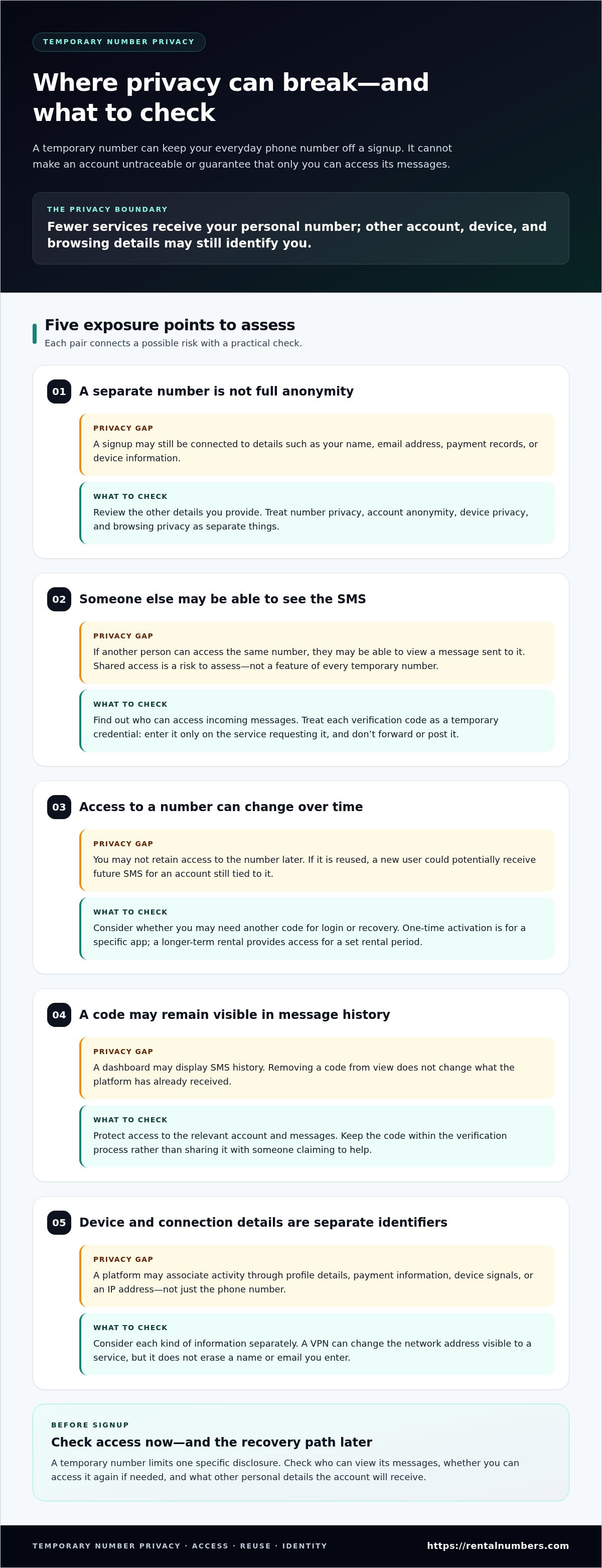
Exposure can happen at several points, not only when a code arrives. Trace the full path: someone gains access to the number, a verification SMS is received, the message appears in an SMS history view, and the code is entered into an account. Each point has different risks. A number may be accessible to more than one user or may later be reused, but that isn’t true of every temporary number.
Access to a number can change over time, so a number you can use now may not remain available to you later. Keep this in mind if an account could require another code for login or recovery. A dashboard may also display SMS history, so protect access to the relevant account and messages. Deleting a code from view doesn’t change what the platform has already received.
Shared access, number reuse, and verification messages
If another person can access the same number, they may be able to see a message sent to it. If a number is later reused, a new user could potentially receive future SMS messages for accounts still tied to that number. These are risks to assess, not evidence that every temporary number is shared or reused.
Treat each verification code as a temporary credential. Enter it only on the service requesting it. Don’t forward it, post a screenshot, or share it with someone claiming they need it to help. For a clearer view of the code-receipt process, see how SMS verification works.
Account and device details can still identify you
SMS exposure is only one part of the picture. A platform may receive information from the account details you provide or the device and connection you use. Reusing a username, signing up with a personal email address, adding recognizable profile details, or providing payment information can connect an account to other activity. Device signals and an IP address are separate from the phone number itself.
A VPN can change the network address visible to a service, but it doesn’t erase a name or email you enter into the account. It also doesn’t remove profile, payment, or device information that the platform collects. Consider these exposure paths separately when deciding what to disclose.
- Number and SMS: Consider who can access incoming messages and whether you may need the number again.
- Account details: Review usernames, email addresses, profile fields, and payment information for links to your identity.
- Device and connection: Remember that these are separate data sources, not protections provided by a temporary number.
To understand how to ensure my temporary number is private, assess each step from message delivery to account access, rather than focusing only on the number. If you need a number for verification, explore temporary SMS verification options as one part of that broader routine.
One-Time Activation or Longer-Term Rental: Which Fits Your Privacy Needs?
Choose based on how long you may need to receive messages, not on an assumption that one option makes you anonymous. A one-time SMS activation is for receiving a code for a specific application. A longer-term rental provides access to a number for a set rental period. Neither option, by itself, guarantees anonymity or control beyond its stated terms.
Start with the account’s likely verification pattern. If you only need one signup code, a one-time activation may fit. If you expect repeat logins or recovery checks, continued access may matter more. Before choosing, consider what you’ll do if you can’t receive a later code.
- One-time activation: A focused option for a single verification need tied to a specific application.
- Longer-term rental: Access to a number during a set period, which may suit accounts that could need verification again.
- Neither option: A guarantee of anonymity, permanent ownership, or control beyond the applicable access terms.
The practical tradeoff is between a single verification task and continued access during a rental period. The right fit depends on the account’s recovery setup and how important continued access is to you.
When a one-time SMS activation may be appropriate
A single verification need is the clearest use case. For example, you may need one SMS code to complete registration for a specific application and not expect to verify by phone again. A one-time activation is designed for that kind of application-specific code receipt, rather than ongoing access to a number.
Before using a one-time option, consider whether the account may later require a code to sign in, change settings, or recover access. Avoid relying on a number you may not retain for accounts where losing access could cause serious harm. Review recovery methods first, and follow the platform’s verification requirements.
When ongoing number access may matter
Repeated verification and account recovery can make continued access useful. A service may ask you to confirm the number again after a login change or account update. A longer-term rental provides access during a set rental period, but it isn’t permanent number ownership. Plan for what you’ll do when that period ends.
If ongoing access fits your use case, compare it with the account’s expected verification needs through long-term number rentals. Then consider the platform’s requirements for virtual numbers, repeat verification, and account recovery. Those rules can differ by service and may change, so don’t assume a number accepted for signup will meet every future account need.
To decide how to ensure my temporary number is private, map the number’s intended use to the account’s lifecycle: signup, future verification, and recovery. Select an option that matches that timeline, and keep the number choice as one part of your wider privacy routine.
How to Use a Temporary Number More Privately: A Practical Checklist
Reduce exposure at each stage: prepare before signup, handle the code carefully, then secure the account. This routine helps you use a temporary number deliberately without treating it as a complete privacy solution.
- Check future access needs. Before requesting a code, decide whether you may need SMS for later logins or account recovery. Review the service’s recovery options first. Don’t use a number you may not retain as your only recovery route for an account where losing access could cause serious harm.
- Minimize signup details. Provide the information the service requires, but avoid adding personal details that aren’t necessary for the account. A separate number won’t separate your identity from a personal email, recognizable username, or profile information you choose to share.
- Set a unique password. Create a password you don’t use on other accounts. Reusing credentials can link accounts and increase the impact if one password is exposed. Review the service’s recovery choices before you finish registration.
- Receive and enter the code discreetly. Use the SMS code only on the service that requested it. Don’t send it to another person, forward it, or leave it visible in a screenshot or message. Treat it like a temporary credential: anyone who can use it may be able to complete that verification step.
- Review security settings after signup. Check the account’s privacy and security controls. Look for available multifactor authentication methods beyond SMS, such as an authenticator app or security key, and enable an option that fits your needs if the service offers one.
- Confirm recovery details. Make sure you can access the recovery email or other methods you selected. If the account still depends on SMS, understand what happens if you can no longer access the number. Update recovery settings while you can still sign in.
Checklist summary: Number privacy limits exposure of your personal phone line. Overall account security also depends on strong, unique credentials, careful handling of verification codes, and recovery methods you can access.
If you’re ready to apply this routine to a signup that needs SMS verification, explore temporary number options and choose an access period that matches your verification needs.
How RentalNumbers.com Fits Into a Privacy-Conscious Verification Routine
RentalNumbers.com provides temporary numbers that receive SMS verification codes for supported apps and websites. Use a separate number for a signup that needs SMS verification, keeping your personal number out of that step. Then match the access type to the task: a single app-specific code or access during a set rental period.
The dashboard supports rental management, displays SMS history, and tracks transactions. These tools help you keep track of your verification activity. They don’t make a number anonymous or remove information an account platform collects. Treat the number as one part of a broader routine: limit unnecessary signup details, handle verification codes carefully, and secure account recovery options.
Choose the verification option that matches your use
For a single app-specific SMS verification, one-time activation is designed to receive a code for that application. If you expect to need continued access, a longer-term rental provides access to a number for a set period. It isn’t permanent ownership, so consider how long you may need the number before you start signup.
Start by identifying the application and why it needs a code. Then consider whether you might need SMS again for login or recovery. Review available numbers for verification and choose an option that fits your intended use. Platform requirements can vary, so account for the service’s rules on virtual numbers and later verification before relying on a number for an account.
Keep expectations clear when using a temporary number
A separate number can reduce direct exposure of your personal line, but it doesn’t control every data point associated with an account. The platform may still receive your signup details, profile information, device data, or payment information. Review what you enter and the account’s recovery settings, especially if you may not retain access to the number after its intended use.
Use the dashboard to manage rentals and review SMS history as needed. Treat any code as a credential: enter it only in the service that requested it, and don’t share it in messages or screenshots. Don’t assume that an SMS history view, a rental period, or a separate number means messages are encrypted, deleted, or accessible only to you. Those claims aren’t implied by the verification function.
If you’re asking how to ensure my temporary number is private, match the number to the application and duration, then manage the account with the same care. Number choice is one privacy layer, not a guarantee of anonymity. Choose a number for SMS verification that fits your intended use.
Make Your Next Signup a Deliberate Choice
Before your next signup, decide what information you’re willing to share and how you’ll maintain account access afterward. That pause can help you choose a verification method that fits the account instead of treating every signup the same. If you’re still asking how to ensure my temporary number is private, focus on what you can control: the details you provide, who can access verification messages, and the recovery methods you keep available.
Use a temporary number as one part of that plan. Match it to the application and the access period you need, then review your account settings after registration. Keep expectations practical. A number can reduce exposure of your personal line, while careful account management helps address other privacy and security risks.
Ready to choose a number for your next verification? Choose a number for SMS verification and take the next step with a clear plan.
Frequently Asked Questions
Does a temporary number make me completely anonymous online?
No. It can keep your personal phone number off a signup form, but it doesn’t hide information you provide or data linked to your account. For example, a familiar username or personal email can connect a new account to your existing profiles. If your goal is to learn how to ensure my temporary number is private, assess what the service can learn from the whole signup, not just the phone field.
Can someone else see an SMS verification code sent to a temporary number?
Possibly. It depends on who can access the number and the system that receives its messages. If an SMS is available through a dashboard, anyone with access to that dashboard may be able to view its history. Don’t share dashboard credentials or verification codes. Enter a code only into the service that requested it, and avoid leaving it visible on a shared screen or in a screenshot.
What happens if I lose access to the number linked to my account?
You may be unable to receive a login or recovery code sent to that number. First, try the account’s other recovery options, such as a registered email address or an authentication method you already set up. If you can still sign in, replace the number in the account settings and test the new recovery route. Each platform handles recovery differently, so follow its account-recovery process.
Is it safe to use a temporary number for banking or financial accounts?
Use caution. A financial account may require phone verification again during a login, security review, or recovery attempt. If you can’t access the number then, regaining access could be difficult. Review the institution’s verification requirements and choose a recovery method you expect to retain. Don’t use a temporary number as your only route back into an account that holds money or sensitive financial records.
Can an account platform identify me if I use a temporary number?
Yes. A phone number is only one possible identifier. A platform may connect an account to details you submit, such as your name or email, or to information associated with your device and account activity. For example, using the same profile name and email as an existing account can create a link even if you enter a different number. Review each signup field before submitting it.
Does using a VPN make a temporary number more private?
A VPN can change the network address a service sees, but it doesn’t remove the information you enter into an account or change who can access SMS messages. It also doesn’t turn a temporary number into an anonymous account. Treat the VPN and number as separate privacy measures. Review the platform’s permissions and account details directly, and don’t rely on a VPN to correct exposed signup information.
Should I use the same temporary number for multiple accounts?
That depends on your access needs and how much separation you want between accounts. Reusing a number can make recovery simpler while you retain access, but it also creates a shared point connecting those accounts. If access to the number ends, several accounts could depend on a recovery route you no longer control. Consider each platform’s number rules and recovery settings before reusing a number.